
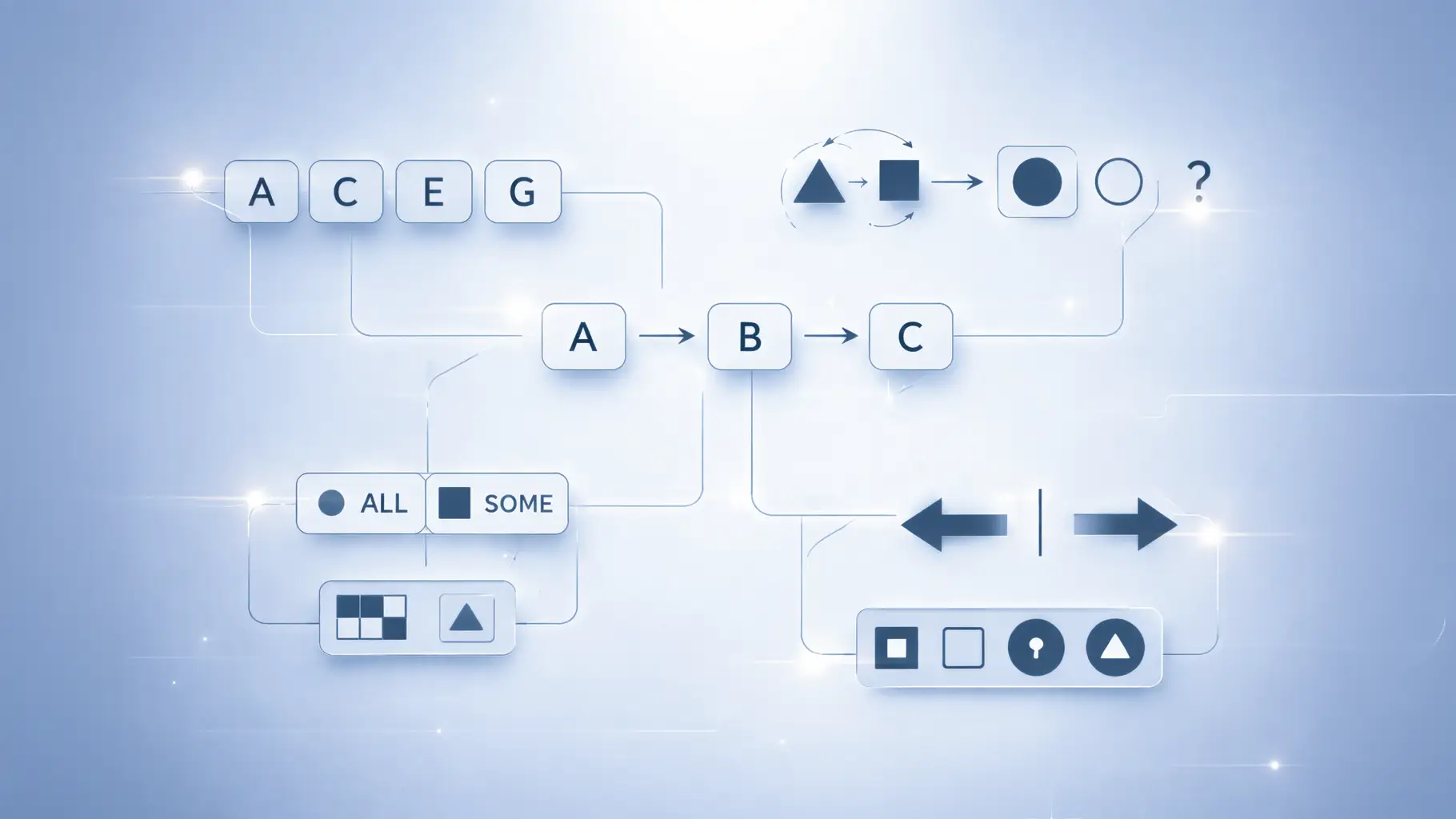
Master Verbal and Non-Verbal Reasoning: SSC Exam Guide
Master verbal and non-verbal reasoning questions for exams like SSC with expert tips and strategies. Improve your skills for success!
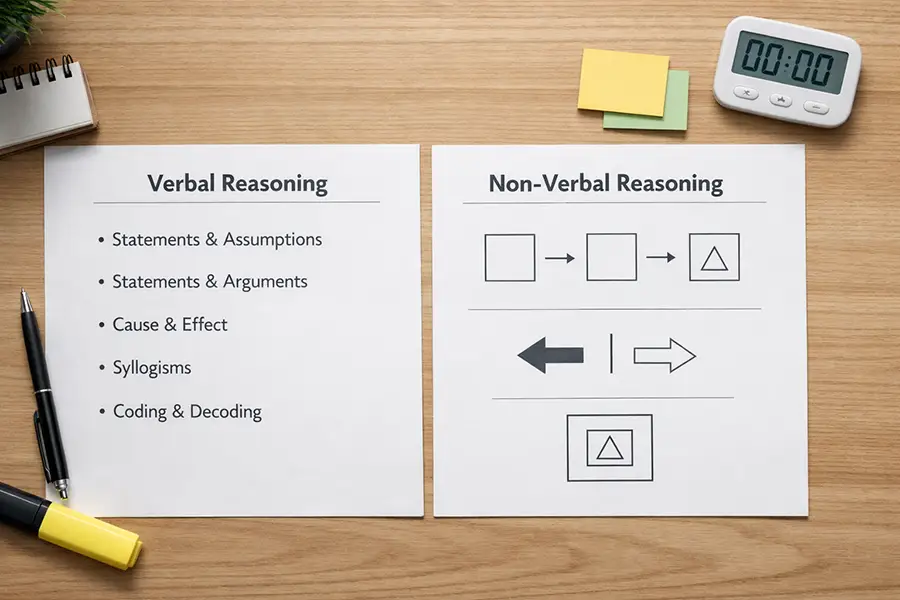
Verbal and non-verbal reasoning questions
If you Googled verbal and non-verbal reasoning questions, then you are probably preparing for government exams like SSC, UPSC CSAT, bank exams, State PSCs, railways, or maybe campus placement. And you have most likely come to the conclusion that reasoning questions are everywhere.
In competitive exams, it’s not just about memory recall; they also test your ability to think quickly, spot patterns, and solve problems under pressure. That’s where verbal reasoning and non-verbal reasoning questions come in.
Let’s start with verbal reasoning.
Verbal Reasoning Questions
Verbal reasoning tests your ability to understand information given in words and draw logical conclusions. Unlike math or general Knowledge (GK), you can’t just memorize to get away; it’s all about thinking under stress.
Below are the important questions in verbal reasoning that almost all exams have:
1. Statements & Assumptions
You are given a statement and need to identify the assumption being made.
Example: “The government tends to provide more schools in rural areas.”
Assumption: There is not enough education in rural areas currently.
Tip: Always be sure the assumption has a direct connection to the statement, and not something else.
2. Statements & Arguments
In this case, you determine if an argument is strong or weak.
Example: “Should mobile phones be allowed in schools?”
Argument 1: Yes, as they can use them for learning applications. (Strong)
Argument 2: No, because my cousin failed when he used a phone too much. (Weak—too personal).
3. Statements & Conclusions
You are asked to find out about what logically follows from a statement.
Example: “All engineers are problem-solvers. Samir is an engineer.”
Conclusion: Samir is a problem-solver.
4. Cause & Effect
You decide whether one event caused another.
Example:
Statement 1: Heavy rains caused flooding in the city.
Statement 2: Several trains were delayed.
Yes, these are cause-and-effect related.
5. Course of Action
You judge the best step in response to a situation.
Example: “Many accidents are happening at a crossing. What should be done?”
Install traffic lights (valid).
Ban all vehicles (extreme, not valid).
6. Coding & Decoding
Words are represented in another way, and you need to break the rule.
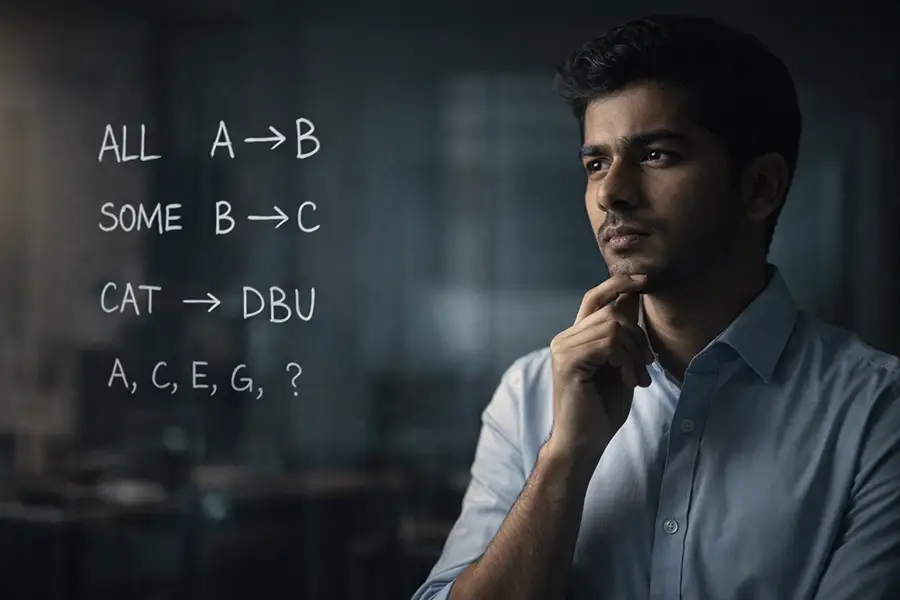
Example: “If CAT = DBU, then DOG = ?”
Rule: Each letter is +1, so DOG = EPH.
7. Series (Numbers & Letters)
Number Series: 2, 4, 8, 16, ? (Answer: 32, doubling with each step).
Letter Series: A, C, E, G, ? (Answer: I, every other letter).
8. Blood Relations
Family tree-based questions.
Example: “Ravi is Anil’s son’s brother. How is Anil related to Ravi?” Answer: Son.
9. Directions & Distance
Checks your concept of movement.
Example: A person travels 3 km towards the north, then 4 km towards the east. How far from the initial point is he?
Use Pythagoras > 5 km.
10. Puzzle Problems
These questions take the most time in exams.
Example: 5 friends standing in a row. A is to the left of B, C is to the right of A, D is between B and E. What is the order?
These often follow from seating arrangements.
11. Syllogisms
Use logic with “All, Some, None” type sentences.
Example: All dogs are animals. Some animals are cats. Some cats may be dogs? (Not necessarily).
If you want to practice verbal reasoning questions and answers, then this logical reasoning online course provides topic-wise quizzes + mock tests. Instead of PDFs in random order, you will get organized practice specifically designed for various exams.
Non-Verbal Reasoning Questions
Non-verbal reasoning is all about solving problems without words. Instead of sentences, you will get shapes, figures, patterns, and sequences. This section of the exam tests your visual thinking ability, pattern recognition skills, and application of logic. They might prove to be tough at first, but after you figure out the logic, they are among the easiest marks you can get.
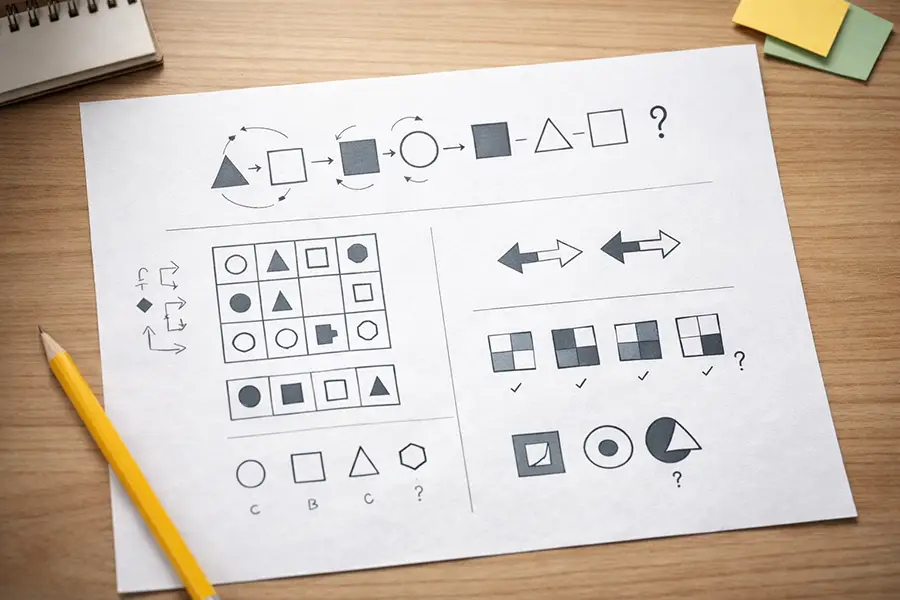
Below is the list of non-verbal reasoning questions which you need to practice:
1. Classification (Odd One Out)
You are presented with a set of numbers, and you have to identify the odd one out.
Example: Four figures → three are circles of different patterns, one is a square. Answer = square.
Tip: Identify one characteristic that disrupts the sequence—varied sides, shading, or position.
2. Analogy
Just like word analogies in verbal reasoning, here you compare shapes.
Example: Square → Cube, Circle → ? Answer: Sphere.
Tip: Always look for 2D → 3D, rotation → reflection, or size → shape correspondence.
3. Series Completion
A series of shapes is given, and you must choose the next one.
Example: A triangle rotates 90° each step. What’s next? Solution: Triangle rotated even further.
Tip: Focus on position, rotation, shading, or number of objects.
4. Mirror Images
You must visualize how a shape would look in a mirror.
Example: If the letter “P” is written in front of a mirror, it becomes reversed with the curve on the opposite side.
Tip: Visualize the figure folding along a vertical line. Left to right.
5. Water Images
The same as mirror images, but using water reflection.
Example: If “M” is written on water, the bottom half becomes turned upside down.
Tip: Visualize the top-to-bottom reversal.
6. Figure Matrix
A set of figures in a table (matrix), with one missing.
You must find the missing one based on the pattern.
Example: In each row, shapes gain an extra side. The missing figure continues the rule.
7. Paper Folding & Cutting
You see a paper folded, and a small cut is made, and you must try to guess the final shape when unfolded.
Example: A Paper folded in half, and a circle is cut. When unfolded → two circles symmetrically appear.
Tip: Symmetry is the key. Cuts reflect across folds.
8. Embedded Figures
A figure is hidden in a complex diagram, and you must discover it.
Example: Find the triangle hidden in a star.
Tip: Watch one shape at a time. Don’t confuse with extra lines.
Tips & Tricks for Verbal and Non-Verbal Reasoning Questions
It is not about learning too much theory. It’s about learning to approach questions smartly during exam pressure. The following are some tried and true tips that work equally well for SSC, UPSC CSAT, bank exams, railways, and campus recruitments.
1. Time Management
- Don’t get stuck: If a seating plan or puzzle is taking over 3–5minutes, highlight and skip. One tough question should not cost you 4 to 5 easy ones.
- Start with scoring questions: In verbal, speed questions like coding-decoding, blood relations, or syllogisms can give you instant marks. In non-verbal, finish series and classification before mirror/water image questions.
- Practice tests: The only way to really master time management is to simulate the actual exam by taking practice tests.
2. Apply Elimination Techniques
- Most reasoning questions are multiple choice. Even if you have no idea, you can usually eliminate 2–3 incorrect answers right away.
- Example: In syllogisms, if the conclusion makes a statement about “all,” check if the statement even deserves to make such a definite statement. If not, eliminate.
- For non-verbal reasoning (e.g., figure series): rule out figures not in sequence instead of looking directly for the correct one.
3. Deconstruct Patterns
- For seating arrangements: Do simple sketching instead of solving everything in your head.
- For series (numbers, letters, figures): Identify differences, positions, and cycles of repetitions.
- For puzzles: Draw down what remains constant first, and then verify conditions one by one.
Resources & Prep Strategy
When it comes to reasoning, there is no shortage of material. The problem is too much material, PDFs, Telegram channels, YouTube videos, and books confuse students. This is what truly works:
Books (for basics)
R.S. Aggarwal – A Modern Approach to Verbal and Non-Verbal Reasoning. Perfect for beginners, but questions are largely outdated in terms of today’s exam level.
Free PDFs & Practice Papers
Yes, there are hundreds of “reasoning questions and answers PDFs.” They are useful for practice after you have built the foundation, but they won’t give you strategy or time management skills. You will spend more time going through the questions to find out if they apply to your exam than answering them.
Online Courses (Best Option)
Instead of scattered material, a structured course keeps you on track.
This Logical Reasoning online course has short, exam-style animated lessons so you won’t be put through 30+ hours of boring lectures.
Reasonable price (Just Rs 599) as opposed to ₹4000–₹8000 like on big coaching websites.
Start your reasoning preparation the right way today. Don’t leave your score to fate.
Join Logical Reasoning Online Course NowConclusion
Verbal and non-verbal reasoning questions are a part of almost all competitive exams. They decide speed, accuracy, and most often the key factor of final marks between selected and rejected candidates.
The mistake most students make is only relying on free PDFs or messy YouTube videos. That will help you clear a couple of questions, but it will not provide the foundation you need to crack exams.
If you want a structured path with quizzes and mock tests in one place, you can start here.
FAQ on Verbal and Non-Verbal Reasoning Questions
Q1. How is verbal reasoning different from non-verbal reasoning?
Verbal reasoning uses words or sentences to test logical thinking (e.g., syllogisms, coding-decoding, blood relations). Non-verbal reasoning uses shapes, figures, and patterns (e.g., mirror images, series, paper folding).
Q2. Would PDFs of reasoning be enough to prepare for an exam?
PDFs can be helpful for practice, but are random and old in nature. A structured online course of reasoning is more valuable as it gives you exam-oriented lessons, topic-wise quizzes, and mock tests.
Q3. How much reasoning should I do daily?
For every exam, 1-2 hours of uninterrupted reasoning practice daily for 1-2 months will do. You will learn faster with a proper strategy and mock tests.
Q4. What are the most important verbal reasoning topics?
Syllogisms, coding-decoding, series, blood relations, directions, and puzzles are important topics in SSC, banking, and UPSC exams.
Q5. What are the most important non-verbal reasoning topics?
Mirror images, figure sequences, categorization, paper folding, and hidden figures come up quite frequently in exams.