
Reasoning All Topics List: The Complete Guide for 2026 Exams
Master reasoning all topics list for exams like placements & SSC CGL. This guide covers syllabi, key topics, and tips to excel in logical reasoning.
Detailed Reasoning Across Topics Guide
It can become tough to study for reasoning tests. Whether placements, SSC CGL, or any other competitive exam, success starts with your understanding of the entire reasoning syllabus. Logical reasoning isn’t just solving questions correctly; it is providing your brain with a good workout of thinking, analyzing, and making smart decisions.
This guidebook will give you a complete list of topics for reasoning, from easy chapters to challenging problem types, so that you know what to prepare.
Why Logical Reasoning Is Needed
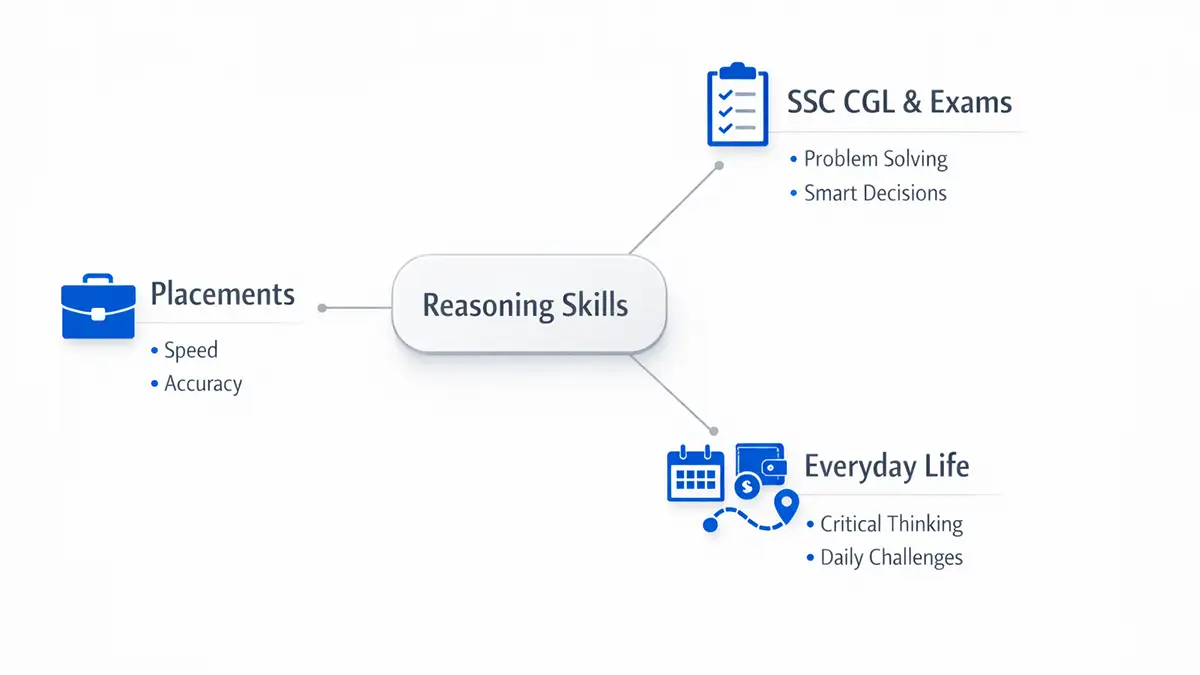
Logical reasoning is a important part of both placements and government exams, such as SSC CGL:
- For placements: Organizations conduct reasoning tests to determine how well and how fast you can think, and how easily you can do so. Your good reasoning score indicates to employers that you can respond quickly, respond to difficulties, and rationalize logically.
- For SSC CGL and other tests: Reasoning is usually a scoring segment. Practiced thoroughly, you can complete the majority of questions more quickly than in the numerical sections.
- In everyday life: Logic helps you make wiser decisions, whether it’s organizing a trip, managing money, or resolving problems at work.
Key Logical Reasoning Topics for Placements
If you are preparing for campus placement or recruitment exams, these reasoning topics are generally important:
Analogy
Analogy questions examine how well you understand relationships between two things. You are given a collection of related words, numbers, or things, and must complete another set using the same relationship. For example, Doctor: Hospital:: Teacher: School. The logic is that a doctor is employed in a hospital, therefore a teacher is employed in a school.
Series Completion
In series completion, you are asked to find the missing element in a sequence of numbers, letters, or symbols. The task is to identify the underlying pattern, such as addition, multiplication, or alphabetical order. For example, 2, 4, 8, 16,? The answer is 32 because the pattern doubles each time. Spotting the rules quickly is the key to solving these questions.
Coding–Decoding
These puzzles employ a unique code to swap words or digits, and you have to find the pattern. Letters may be shifted, replaced, or rearranged; other times, numbers substitute for letters. For example, if CAT = DBU, then the word DOG becomes EPH. Solving them requires attention to detail and quick recognition of patterns.
Blood Relations

Blood relationship problems have family trees, and you must determine how two people are related. The question might be, “A is the sister of B’s father”, and ask you to decide how A is related to B. To discover that, you break down each relation step by step. B’s father’s sister is B’s aunt. Drawing a diagram of the family generally makes these simpler to solve.
Direction Sense
These are directions where one is going in different directions, and you have to compute their last position or the direction they are heading. For example, if one walks 4 km north and then another 3 km east, you compute where they are compared to the starting point. Others have right and left turns that one has to track with precision. Charts organize movements in sequence.
Syllogism
Syllogism problems test your ability to make conclusions from given statements. For example, all cats are animals. Some animals are dogs. You may be asked whether “Some dogs are cats” is true or false. The goal is to apply deductive reasoning and check which conclusions are logically true based on the given statements.
Puzzle Test
Puzzle questions are situations with more than one condition, and you need to put or assign things the right way. Common ones are seating orders, floor arrangements, or job assignments to people. You solve them by carefully reading each condition and building the arrangement in stages. These require patience and reasoning.
All these are discussed in this Logical Reasoning Online Course, explained step by step with animated examples so you don’t waste time figuring things out alone.
Reasoning Chapters for SSC CGL
The SSC CGL reasoning section is broader and includes both verbal and non-verbal questions. Important chapters are:
Verbal Reasoning
Verbal reasoning questions are based on words and written statements rather than figures. Topics include syllogism, statement–conclusion, coding–decoding, and blood relations. The goal is to interpret given information logically and answer based on the conditions provided, without adding your own assumptions.
Non-Verbal Reasoning
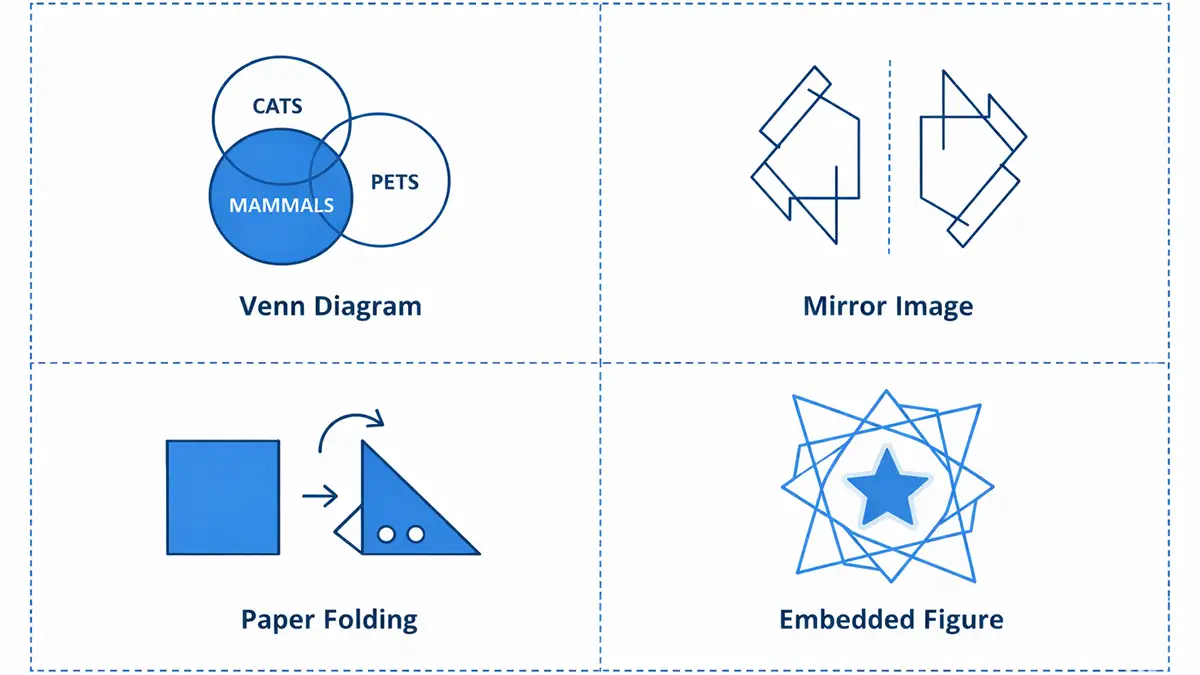
Non-verbal reasoning is based on pictures, patterns, and figures. Common question types include mirror images, water images, embedded figures, and paper folding. You need to visualize shapes, rotations, or reflections to find the correct answer. These problems test visual and spatial reasoning skills.
Logical Sequence of Words
In this type, you are asked to arrange given words in a natural or logical order. For example, Childhood → Education → Career → Retirement. The challenge is to understand the correct sequence based on meaning, time, or hierarchy. These are usually straightforward if you carefully think through the order.
Venn Diagrams
Venn diagram problems present sets of objects or groups, and you must show or interpret their relationships. For example, you may be asked to show the connection between Doctors, Engineers, and Women. Circles are drawn to represent groups, and overlaps show shared members. These problems check your ability to classify information correctly.
Classification (Odd One Out)
In classification, you’re given a group of items and must choose the one that doesn’t belong. For example: Apple, Banana, Mango, Chair. Since three are fruits and one is furniture, the Chair is the odd one. These questions test your ability to quickly recognize similarities and differences.
Clocks & Calendars
Clocks involve questions on calculating angles between hands, finding times when hands coincide, or when they are opposite. Calendar problems involve finding the day of the week for a given date or identifying recurring patterns. Both types follow fixed rules and formulas, which make them predictable once learned.
Data Sufficiency
In data sufficiency, a question is asked along with two or more statements. You must decide if the given information is enough to answer the question. The key point is that you don’t always solve the problem; you just check whether the data provided is sufficient. This tests judgment rather than calculation.
Full Reasoning Syllabus (Master List)
Here’s the reasoning full syllabus, neatly divided into categories. Use this as a checklist to track your preparation.
1. Verbal Reasoning
- Analogy
- Classification (Odd One Out)
- Coding–Decoding
- Blood Relations
- Direction Sense
- Series Completion (Numbers & Letters)
- Syllogism
- Logical Sequence of Words
- Statement & Assumption
- Statement & Conclusion
- Statement & Argument
- Cause & Effect
2. Non-Verbal Reasoning
- Mirror Images
- Water Images
- Paper Folding & Cutting
- Embedded Figures
- Figure Series Completion
- Classification of Figures
3. Analytical Reasoning
- Puzzle Test
- Seating Arrangement (Linear, Circular, Square)
- Data Sufficiency
- Decision Making
- Logical Deduction
- Critical Thinking
4. Special Reasoning Topics
- Clocks
- Calendars
Covering these reasoning chapters ensures you are ready for both placements and the SSC syllabus.
Want guided practice instead of guessing patterns alone?
If you’d like guided lessons with animations, quizzes, and practice problems, this Logical Reasoning Online Course is designed to help you cover the entire syllabus step by step. It’s a smart way to prepare without confusion.
View the CourseTips for Excelling in Reasoning Exams
- Practice Regularly – Build speed and accuracy with daily practice.
- Strengthen Basics First – Don’t jump into puzzles before mastering simpler chapters.
- Use Elimination – Narrow down answer choices in multiple-choice questions.
- Manage Time – Allocate time per question during practice so you don’t get stuck in exams.
- Stay Calm – A cool mind solves faster. Stress often leads to silly mistakes.
FAQs About Reasoning Topics
Analogy, series completion, coding–decoding, blood relations, directions, syllogism, and puzzles are the most common placement topics.
The reasoning SSC syllabus usually includes 15–20 chapters, covering both verbal and non-verbal reasoning. Key areas include syllogisms, Venn diagrams, puzzles, classification, and figure-based problems.
SSC CGL reasoning is broader and includes non-verbal questions, but with practice, it can be one of the easiest scoring sections. Placement exams usually keep reasoning shorter but are more speed-focused.
Yes, with regular practice, you can complete the syllabus in 1–2 months. Focus on basics first, then practice puzzles and decision-making questions.
Make a daily schedule, solve previous year papers, and use structured resources. An online course simplifies this with animated lessons and quizzes for each chapter, so you don’t waste time figuring things out alone.