

If you have landed on this page, you are probably searching for the best logical reasoning Online course. You might be preparing for competitive exams, government exams, or entrance exams that include reasoning. Whatever exam you’re targeting, one thing is sure: good reasoning can make a tremendous impact on your score.

Logical reasoning is not an ordinary topic, as it tends to distinguish the top performers from the crowd. Reasoning has always been a big part of competitive exams like government exams, entrance exams, or placement exams. It shows your ability to think clearly under pressure.
For example:
This is why so many people look for logical reasoning online courses. They need something structured that covers exam-level questions and gives useful tips, not theory.
Looking for a shortcut?
This logical reasoning course is tailor-made and covers all the exams.
Click here to begin!
Not all reasoning courses are made equal. Search for these must-have features prior to enrolling:
Ask yourself: for which exam or scholarship do you wish to prepare? How many hours can you study daily? Being clear about your goals ensures that you choose the right course instead of wasting time on the wrong one.
A good course should include all the topics of verbal and non-verbal reasoning, analytical reasoning, and other essential sections. Here is what a complete logical reasoning course should include:
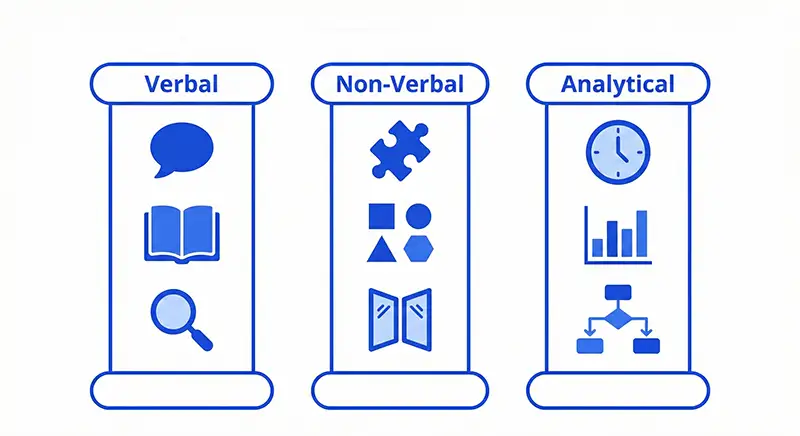
These topics are found in almost all exams that test logical reasoning; while they vary in difficulty depending on the exam, the fundamental skills needed to solve them remain the same.
Lectures by themselves will not increase your reasoning speed. Any proper course must include topic-wise quizzes and full-length mock tests. This helps you build accuracy while learning time management under exam conditions.
The study material should consist of brief, simple, and exam-focused lessons. There is no need for extensive courses that provide 30+ hours of instruction. Logical reasoning doesn’t call for a degree-level class. You just need a good foundation to use in exams.
Reasoning is a skill, not rocket science. You do not need to pay ₹3,000-₹5,000 ($100-$200) or buy high-cost subscriptions for other subjects you have no need for. A good logical reasoning course should be available for less than ₹1,000 ($40)
If you want a course that checks all the points above in one place, you can explore our Logical Reasoning & Analytical Ability course here: View course details.
One of the biggest advantages today is that you do not have to depend only on local coaching centers for reasoning preparation. With online reasoning classes, it is possible to learn directly from home at your own pace, and yet get the same (or even better) quality of instruction.
Online courses can be taken at your convenience. You can choose your own time. This is regardless of whether you are working, in college, or preparing full-time. You will not be restricted by the strict timings of a coaching center.
Unlike textbooks or simple PDFs, online courses have practice quizzes, simulated exams, and even online discussion forums. This is active learning instead of passive learning, and it’s closer to the real exam experience.
In short, online reasoning courses remove the limitations of time and location. All you need is an internet connection, and you can start developing your reasoning skills step by step.
There are hundreds of reasoning resources online. Here’s a comparison of popular logical reasoning online courses based on key features.
| Feature | Our Course | Udemy / Coursera | Unacademy / BYJU’s / Testbook / Oliveboard / Adda247 |
|---|---|---|---|
| Exam Coverage | All exams that have a reasoning topic | GRE, GMAT, general aptitude | SSC, UPSC, Bank, Railways, State PSC, mixed with other subjects |
| Topic Coverage | All aptitude/reasoning/analytical topics | Basic aptitude, not all reasoning subtopics | Covers most reasoning topics, but scattered across different courses |
| Practice Material | Topic-wise quizzes + full mock tests included | The quiz and mock tests are separate add-ons | PDFs + limited test series (often sold separately) |
| Course Style | Animated video lessons + interactive practice | Recorded lectures, slide-based teaching | Mix of live + recorded, mostly traditional lecture style |
| Lesson Quality | Short, exam-focused lessons for reasoning only | Long, general lectures | Long, multi-subject classes |
| Updates & Relevance | Always exam-pattern based, updated for current year | Not aligned to exams | Updated yearly, but diluted across many subjects |
| Instructor Quality | Dedicated reasoning specialists | General tutors, many unrelated courses | Some subject experts, but reasoning not always their main focus |
| Price & Payment | ₹599 (one-time payment) | ₹900–₹1600 per course | ₹4000–₹8000+ subscriptions |
| Scholarship Opportunity | Yes | None | None |
| Global Career Opportunity | Yes | None | None |
Ready to make your prep simple? Click here to begin structured reasoning prep today.
Start structured reasoning prepThe logical reasoning online course is designed to be simple, low-cost, and focused on building a competitive exam foundation, providing all necessary practice questions in one organized, exam-oriented platform.

Most exam aspirants or students don’t fail reasoning because they are not smart enough, but because of the way they prepare. The following are the biggest challenges:
Students download a few PDFs of logical reasoning questions, join some Telegram or other groups, and watch numerous YouTube videos. The content may be fine, but the problem is that it is not structured. Some content is too easy, some too hard, and much of it does not follow the real exam pattern.
Study habits show that unstructured studying is one of the most significant reasons why students lose focus and give up halfway. Even smart students spend weeks or months gathering scattered material, with very few being able to create an effective study plan. The majority waste precious time only on building a plan, instead of actually studying or practicing.
Reasoning questions tend to look simple at first glance but can actually take a lot more time to solve than expected. Puzzles, seating arrangements, and coding-decoding can be time-consuming. This is especially true if you do not have strong basics, shortcuts, or methods. Even a single question that takes 10 minutes can throw off your timing for the whole exam.
Self-study often just involves solving questions. An online course gives a chance to learn shortcuts and time-saving methods. It also shows you how to avoid typical mistakes. Such ability is useful when you are under exam pressure.
Most students procrastinate, skip topics, or postpone when self-studying. When you do an online course, you receive a fixed schedule, practice quizzes, and regular mock tests to keep you consistent.
The best reasoning course would encompass the whole syllabus (verbal, non-verbal, and analytical reasoning) with comprehensive practice material, topic-wise quizzes, and mock tests.
Reasoning PDFs are helpful for practice when you have a foundation, but they are unstructured and don’t cover the complete exam pattern. A course gives you structured learning, short lessons, and practice tests, which a PDF cannot give.
With regular practice, most of the students take 1–2 months to build a strong reasoning capability for any logical reasoning test. A course can help you become consistent and improve speed and accuracy.
Yes. A complete course should include verbal reasoning, non-verbal reasoning, data interpretation, analytical ability, clocks, and calendars.